Drive any interstate in America and you'll pass them: a lawyer with folded arms next to a phone number you can't get out of your head. Some version of "we fight for you" is usually in there somewhere. It's easy to write these off as vanity, but the injury-lawyer billboard is probably the most rational object in the whole industry, and it's worth understanding why it exists before arguing about what comes next.
Start with how these firms get paid. A plaintiff firm earns nothing until a case resolves, and one good case can bring in thousands or tens of thousands of dollars in fees. Economics like that let a firm spend money on acquiring clients in amounts no other kind of law practice would tolerate.
Then there's the way people come to need a lawyer. Nobody shops for an injury attorney ahead of time. You need one the day something goes wrong and you choose quickly, so a firm that wants your case has to be a name you already remember. And then there's the law, which rules out the obvious shortcut of finding the injured person and simply asking.
That shortcut has a name. One of the earliest known uses of "ambulance chasers" in print turns up in a New York paper in May 1896, and the example it gives could have come out of a modern speed-to-lead pitch. A man was run over by a wagon on Grand Street at 8:30 one morning, and by 10 a lawyer had interviewed him and arranged to take the case. Chasing is what the market did on its own. Contingency fees turned every injury into a potential asset, and because the need came out of nowhere, whoever got to the victim first had the edge.
A good share of the ethics rules on client acquisition grew out of the profession's effort to stamp that out. The ABA's first ethics code, adopted in 1908, condemned seeking out people with injury claims, hiring runners to do it, and paying police, doctors or hospital staff to steer the injured toward a lawyer. For most of the century after that, lawyers couldn't chase clients and couldn't advertise to them either. When the Supreme Court opened up advertising in 1977, chasing stayed off-limits and the billboard took its place. (The insult stuck around anyway.)
What you end up with is an industry that buys attention in advance, in bulk, from people who aren't its customers yet and mostly never will be. Think of a billboard as an option on a future accident.
My argument in the rest of this piece is that personal injury has spent decades optimizing the most visible and least defensible part of its funnel, and that the real advantage now sits in the parts nobody can buy at auction.
The wall
Nobody designed the modern rules on client acquisition as a market. Courts, bar regulators and Congress built them piece by piece over nearly four decades, and it's only when you lay them end to end that you notice how neatly they fit together. Bates v. State Bar of Arizona came first, in 1977. The Supreme Court extended commercial-speech protection to lawyers and allowed truthful newspaper advertising, and you can date the billboard economy from there.
The Court drew its first hard line a year later. Albert Ohralik, an Ohio lawyer, had personally solicited two eighteen-year-old women after a car accident, and he visited one of them while she lay in traction in a hospital bed. In Ohralik v. Ohio State Bar Association, the Court upheld his suspension 8 to 0. Advertising to the public was protected speech, and showing up at the bedside wasn't.
Mail ended up somewhere in between. In 1988 the Court treated a solicitation letter as a different thing from a lawyer at the bedside, but in 1995, in Florida Bar v. Went For It, it upheld Florida's ban on targeted letters to accident victims and their families for 30 days after the event. That decision was 5 to 4, and a lot of state supreme courts adopted similar waiting periods afterward. To show the ban wasn't too burdensome, the majority listed the ways Florida lawyers could still reach people, from prime-time TV to the Yellow Pages. One line in that list reads: "They may rent space on billboards."
The more recent limits come from statutes and professional rules. In Maracich v. Spears (2013), a group of lawyers had pulled names from state motor-vehicle records and mailed more than 34,000 car buyers, and the Court held that recruiting clients isn't a permitted litigation use of that data under the Driver's Privacy Protection Act. The Telephone Consumer Protection Act puts statutory damages of $500 per message, up to $1,500 if willful, on automated calls and texts sent without consent. And the ABA's Model Rule 7.3 bars live, person-to-person solicitation when a significant motive is the lawyer's fee. The rule's official comment then explains what doesn't count as solicitation, and the first example it gives is a billboard.
Hiring someone else to do the chasing doesn't get a firm around any of this, either. The ABA's rules also bar lawyers from breaking them through the acts of another, so when a vendor crosses the line, the firm that bought the lead can end up owning the problem.
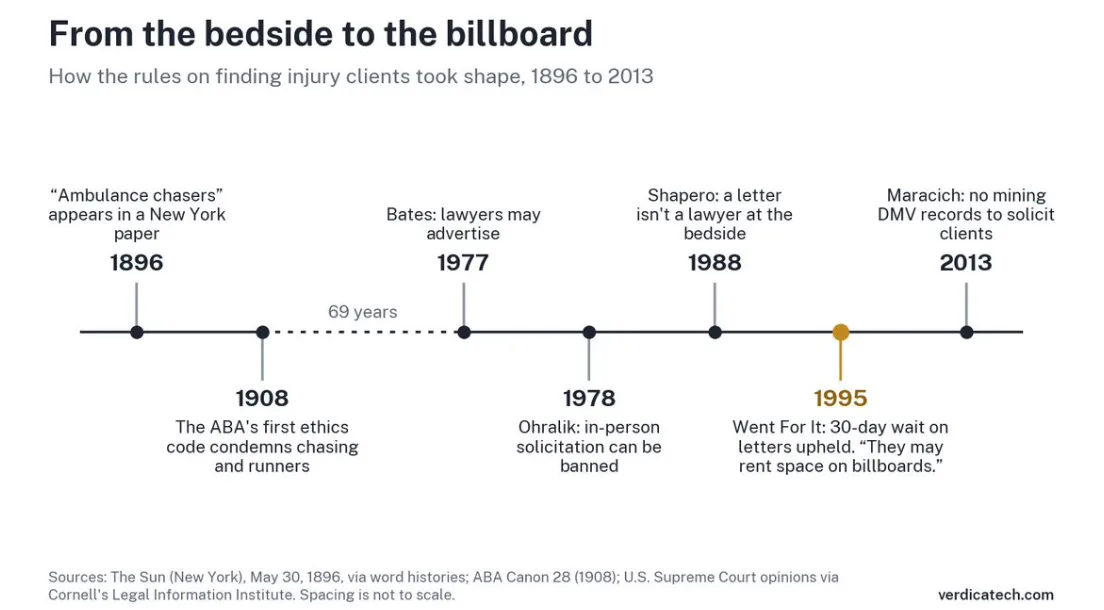
Put simply, the law protects the broadcast and forbids the targeted. A firm can tell everybody, all day long, that it handles car accidents. It can't go find the person who was in one this morning.
I think that's defensible policy. Florida's two-year study documented how intrusive people found letters that arrived in the rawest days after an accident. But the policy has an economic side effect nobody set out to create. Close the efficient channel and the money flows into the inefficient ones, so firms end up buying recall from millions of people in order to be remembered by the handful who'll need them. That's the billboard, basically.
One detail from Went For It matters for later. Writing for the four dissenters, Justice Kennedy pointed out that the other side faced no such wait. Its lawyers, investigators and adjusters remained free to contact the same unrepresented victims to gather evidence or offer a settlement. The wall only binds one side of the case.
The auction
Once the law rules out finding the injured person, there's really one place left where the injured person finds you, and that's the search box. It's the only medium where a firm can see someone's intent at the moment it forms, and it's priced like it.
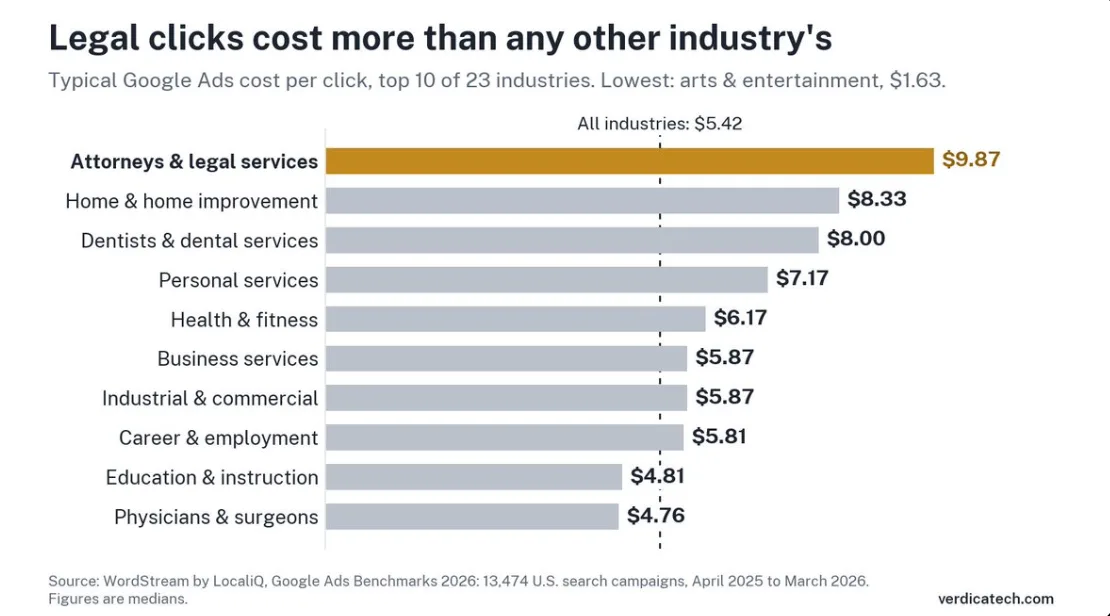
Attorneys and legal services have the highest average cost per click of any industry in WordStream's benchmarks: $8.58 in the 2025 report and $9.87 in 2026, against an all-industry average of $5.42. Those figures blend every legal search together, though, cheap ones included. One legal-marketing agency puts personal injury keywords in competitive metros at $150 to $500 or more per click, and the most contested terms go higher.
The totals point the same way. The American Tort Reform Association, which tracks lawyer advertising because it thinks there's too much of it, counted more than $2.5 billion in legal-services advertising in 2024. That was 39% more spending than in 2020, on 4% fewer ads. Digital is where it's starkest: legal advertisers bought less than half as many digital ads in 2024 as in 2020 and spent 84% more on them. Out-of-home advertising, which includes billboards, went from $150 million in 2017 to $541 million in 2024. (ATRA's state reports this year put the 2025 national total near $4 billion, though I couldn't find the national breakdown behind that number.)
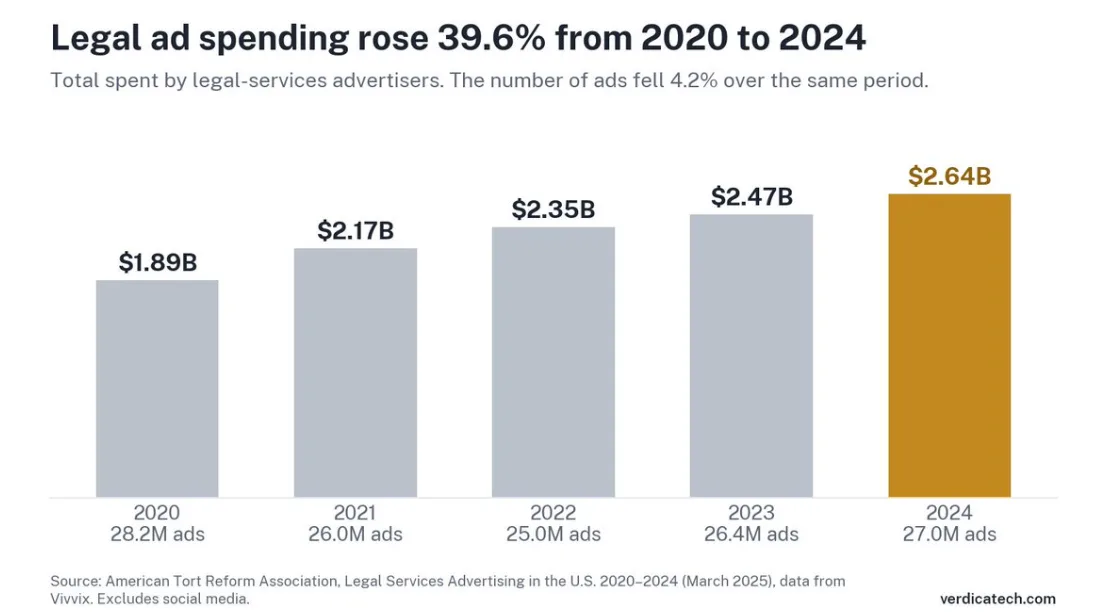
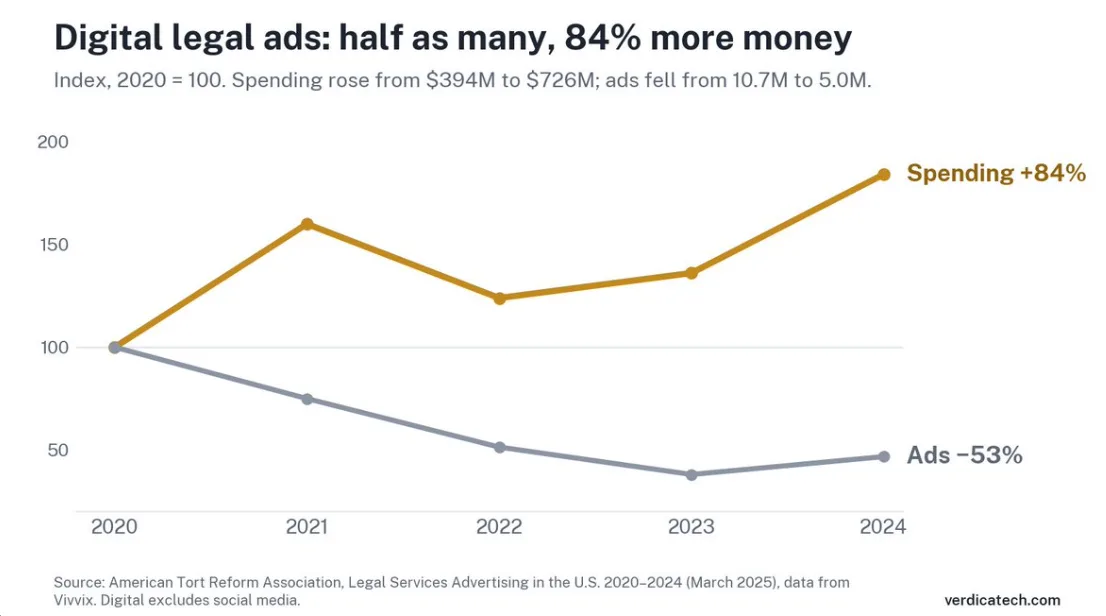
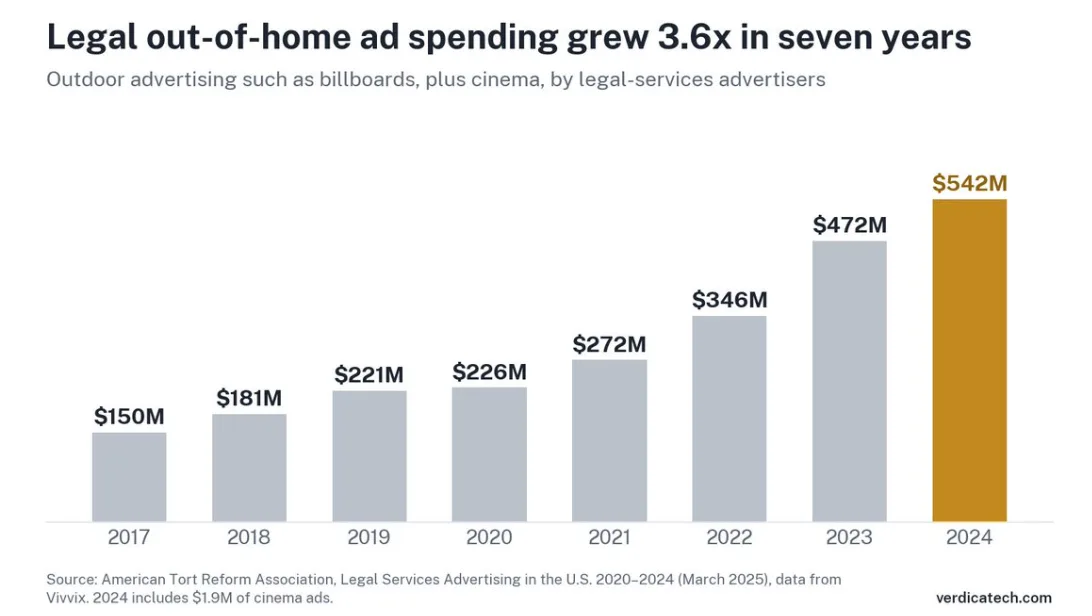
Spending up by more than a third while the number of ads goes down is worth sitting with for a second. The industry is paying more for roughly the same amount of attention.
That's what auctions do. Any big metro has dozens of firms bidding on the same keywords, so the price of a click drifts up toward whatever the strongest bidders can afford. Improvements that anyone can buy, like a better ad or a smarter bidding tool, just push the clearing price up, and the surplus ends up with the auctioneer.
The easiest way I've found to think about this is to split a firm's return on advertising into three numbers:
Fee revenue per ad dollar = inquiries per dollar × signed cases per inquiry × fee per signed case
The market mostly sets the first number. Ad quality moves the price a little at the margin, but competition sets the level, and every competitor can hire the same agencies. The other two numbers belong to the firm. They're decided after the click, by whether anyone answers, how quickly, and what the case turns out to be worth.
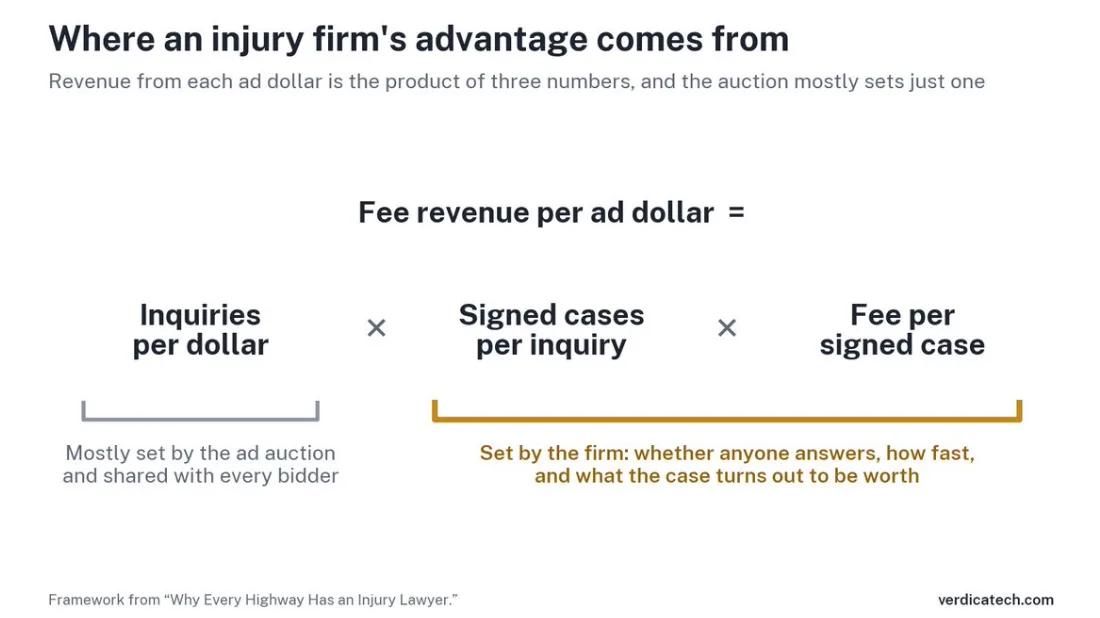
So the firm that wins the auction is usually the one that can afford to bid the most, because it converts more of its inquiries and recovers more per case. Clever ads matter less than people think. Lead aggregators already get this, which is why they can outbid individual firms: they resell one inquiry to several buyers. A single firm's only lasting answer is to get more out of each inquiry than anyone else can.
Who picks up at 9 p.m.?
Once the phone actually rings, the economics flip. The firm has already paid for that call, so whatever happens next either earns the money back or wastes it.
A lot of those calls come when nobody's at the desk. Accidents don't keep office hours, and people call from ERs and tow lots and their kitchen tables whenever they finally get a minute. If an injured person hits voicemail at 9 p.m., the alternative is easy: the next number on the next billboard.
The profession's own data here isn't flattering. In Clio's 2019 Legal Trends Report, 89% of legal professionals said they got back to calls and emails within 24 hours. Then the same report sent mystery shoppers to 1,000 firms, and 60% of them never answered the email. Of the calls that went to voicemail, 57% weren't returned within 72 hours. Clio ran the exercise again in 2024 with 500 firms, and this time 48% couldn't be reached by phone at all, even after they'd been given the chance to call back. Only 33% answered the email.
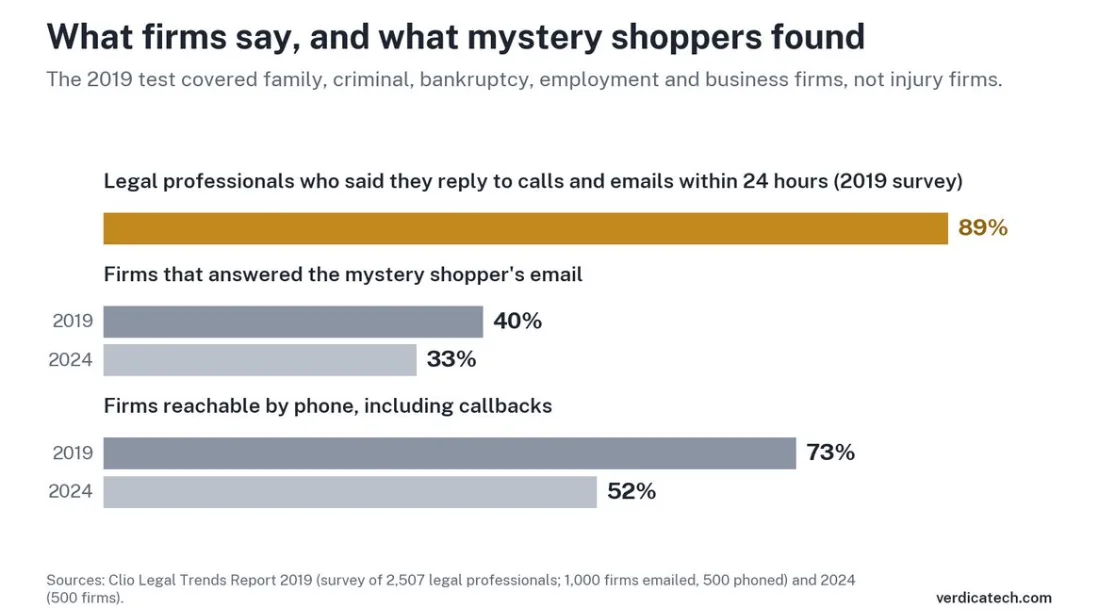
Billboards, jingles and $300 clicks are all spending on the first number, and the first number is the one everybody shares.
To be fair, none of this measures injury firms directly. Clio's 2019 shoppers posed as clients with family, criminal, bankruptcy, employment and business problems, and the 2024 results aren't broken out by practice area. Firms that live and die by intake probably do better than average. But the 2019 consumer survey shows why speed matters so much. In it, 42% of people said that if they liked the first lawyer they talked to, they wouldn't bother talking to anyone else. In personal injury, the first lawyer who picks up is often the only one who gets a shot.
I want to flag something about the numbers that usually get quoted at this point. The famous speed-to-lead stats, like "21 times more likely to qualify," get passed around in legal marketing decks, but they come from general sales research on web leads, not from law firms. The best of that research, a 2011 Harvard Business Review study of 1.25 million leads at 42 companies, co-written by the head of a sales-software company, found that firms that tried to reach a lead within an hour were nearly seven times as likely to qualify it as firms that waited even an hour longer. That's good evidence about human attention, but it says nothing specific about injury clients, and in an industry that argues causation for a living, the distinction should matter.
What I'm confident about is simpler. The call was paid for in advance, its value drops off within the hour, and more advertising won't fix that. Intake is the cheapest lever in the whole funnel, because getting better at it raises the return on every dollar already spent at the top.
Then there's the file
The phone is the first leak. The file is a bigger one.
A signed case isn't revenue yet. It becomes revenue through the demand package, meaning the letter, the exhibits and the damages calculation that ask an insurer to pay. Putting one together means reading every chart, reconciling every bill, finding the weak spots before the adjuster does, and then picking a number. At most of the firms we talk to, that's two to four weeks of paralegal and attorney time per case.
The number is often the shakiest part. A multiplier on medical specials, picked from experience and gut feel, leaves money on the table in strong cases and invites a discount in weak ones. If the attorney can't defend a figure line by line, the adjuster isn't going to pay it line by line.
The other side of the table automated a lot of this long ago. Insurers have been pricing bodily-injury claims with software for more than twenty years, and anyone in the business knows what the defense looks for: gaps in treatment, a late first visit, an old injury to the same body part, no causation opinion. Colossus, long described as the dominant system, turns the injuries and treatment in a file into an acceptable payment range. In court records excerpted by the Consumer Federation of America, an executive at the company that sold it said the software could be tuned toward a target level of savings, for example 15% across all claims, and that some insurers had seen savings of around 19%. Regulators have looked at this too. When Allstate settled with 45 states in 2010 over its use of Colossus, examiners had found it tuned inconsistently across regions, though New York's insurance superintendent said they found no systemic underpayment.
Think back to Kennedy's dissent. The plaintiff's lawyer has to wait 30 days to send a letter, while the adjuster can call tomorrow. And the imbalance doesn't stop at first contact. It runs through the whole case, with one side showing up with a model that can be tuned to a payment target and the other with a spreadsheet and a deadline.
That's the third number from earlier, fee per signed case. Since the three numbers multiply, a 10% gain in what a firm recovers per case is worth exactly as much as getting 10% more inquiries out of the same ad budget. The difference is that a competitor can't bid away your recovery the way it can bid up your clicks.
So where's the edge?
Put all of this together and you get a fairly clear picture of where the competition is heading. The top of the funnel is fenced in by law and priced by auction, so whatever you gain there gets shared with every competitor and, sooner or later, with Google. The advantages that last are further down, in the two numbers nobody can bid on: how many inquiries become clients, and what each of those cases is worth.
Both have the same enemy, which is time. An inquiry goes cold within the hour. A demand that takes a month is a month the client spends waiting, and a month the firm spends carrying the cost of a case it already paid to get.
They also share a constraint, and that's trust. The acquisition rules exist for a good reason, since people going through the worst week of their lives shouldn't be hunted like leads. So any tool that touches intake has to be opt-in by design, where the injured person reaches out to the firm and never the other way around. And any tool that touches valuation has to hold up in front of an adjuster, a mediator and a malpractice carrier, which rules out a number nobody can trace back to its source.
That's the problem we're building Verdica to solve. It takes a firm's raw records and turns them into facts that each cite the page they came from, a settlement range built on a formula the attorney can inspect and adjust, and a finished demand, in minutes instead of weeks. We built it to say plainly when a file is thin rather than paper over the gap, and the attorney stays the authority on everything it produces.
For almost fifty years, since Bates, plaintiff firms have competed on who people remember. I think the next ten will be decided by who picks up the phone, and who can prove what a case is worth.
Back to the billboard
The billboard is the most visible part of personal injury and the least distinctive. Any firm can buy one, and every firm in a market can bid on the same click. What nobody can buy is a person answering the phone at 9 p.m., or a number the firm can defend line by line. Those have to be built.
So the next time you pass one of these signs on the interstate, it's worth remembering what it really is: an option on a future accident, priced by the law and the auction. The firms that come out ahead over the next decade will be the ones that make that option worth exercising.
Notes on sources
-
Everything above links to its source. Where the best evidence I could find is general rather than specific to injury law, I've said so, and a few of these sources have their own stake in the argument, which I've noted.
-
Ambulance chasing: Pascal Tréguer's word histories entry, which reproduces The Sun (New York), May 30, 1896, page 7; the text of ABA Canon 28 (1908) as quoted in a New York County Lawyers Association ethics opinion.
-
Case law: the opinions themselves, at Cornell's Legal Information Institute: Bates, Ohralik, Went For It and Maracich.
-
Professional rules and statutes: ABA Model Rule 7.3 and its comment; the ABA's summary of Formal Opinion 501 on Rules 8.4(a) and 5.3; the TCPA's damages provision, 47 U.S.C. § 227(b)(3).
-
Ad spend: ATRA's Legal Services Advertising in the United States, 2020–2024 (data from Vivvix; excludes social media) and its 2026 New York report for the 2025 estimate. ATRA lobbies to limit litigation, so I've used its counts for scale, not its conclusions.
-
Search costs: WordStream's 2026 and 2025 benchmarks (its "averages" are medians); metro estimates from Custom Legal Marketing, a legal-marketing agency.
-
Intake: Clio's 2019 and 2024 Legal Trends Reports. Clio sells practice-management and intake software.
-
Lead response: James Oldroyd, Kristina McElheran and David Elkington, "The Short Life of Online Sales Leads", Harvard Business Review, March 2011. Elkington was CEO of InsideSales.com.
-
Claims software: the Consumer Federation of America's 2012 report on computerized claims systems, drawing on records from Hensley v. Computer Sciences Corporation (CFA is a consumer advocacy group); Insurance Journal on the 2010 Allstate settlement.
-
Demand timelines: the two-to-four-week estimate comes from our own conversations with firms, not an independent study.
-
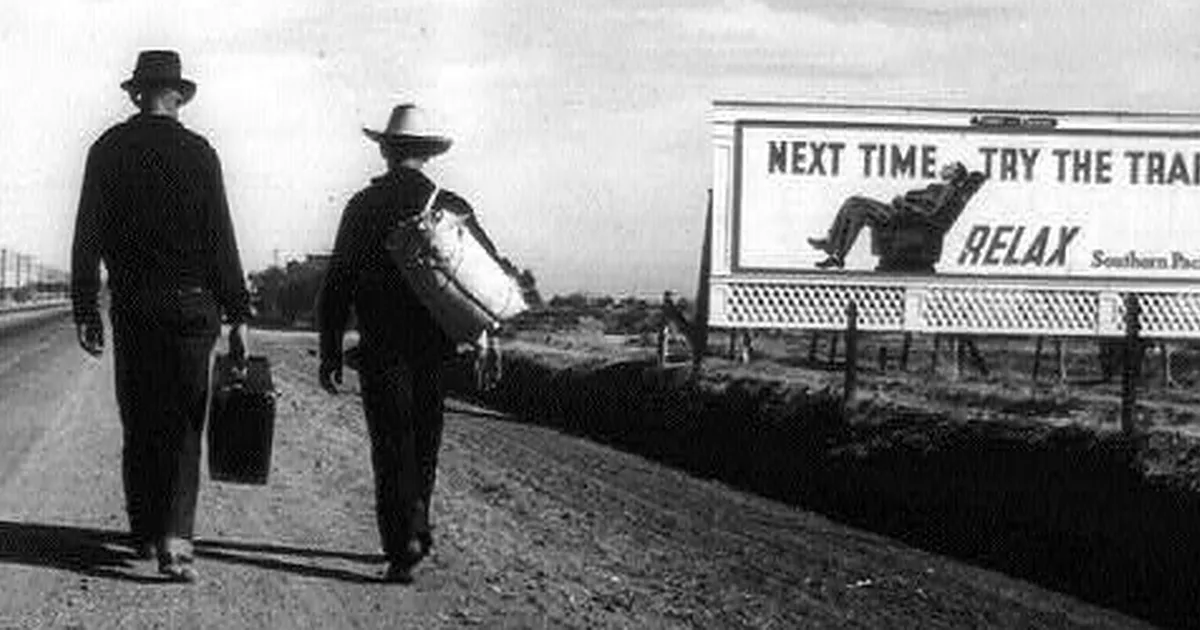
Header photo: Dorothea Lange, Toward Los Angeles, California, March 1937, taken for the Farm Security Administration. Library of Congress, Prints & Photographs Division, FSA/OWI Collection, LC-DIG-fsa-8b31801; no known restrictions on publication.
Corrections: none. If a figure here is ever wrong, we fix it on this line and date the change.
Written for legal professionals. Not legal advice. Verify against current law in your jurisdiction.
Cite this article
Nebiyu Demie, Why Every Highway Has an Injury Lawyer, Verdica Journal (Oct. 3, 2026), https://verdicatech.com/journal/article1.
 Nebiyu DemieCo-founder & CEO - Verdica
More from the Journal